Time flies and the term2 has ended in a flash. In this term, I was exposed to a new teaching method through this course-online learning mode. Instead of having a set amount of time to attend lecture like other courses, this course gives us the freedom to study in our free time, and we can use MOOC for study, discussion and communication. Besides, we have a meeting per month for discussing the problem we have in our independent study. It would be helpful for our research.
Although learning is online, we are required to comments about the other student’s blog, this brings me to have more chances to communicate with others. During the discussions, I gain new insights and knowledge. For example, I read week 3 MOOC, and I told my classmates about the most obvious example of China’s sharing economy — Shared bikes. Some of classmates put comments about the sharing economy was a kind of reuse of resources, which would improve the utilization rate of resources. Under different opinion shock, I think the type of learning through discussion and communication is very beneficial.
On the other hand, the Internet makes communication easier. I can broaden my horizon by reading blogs written by other people. It is convenient for me to discuss with others when I find any enquires.
If you has a programming learning experience, you will find that some languages are not easy to use due to lack of documentation and developer support. Python saves thoes issue. It has been around for a long time and has accumulated a lot of documentation, tutorials, tutorials, and so on. Besides, the Python developer community is incredibly active. This means that when someone needs help or support in any situation, they get a prompt response.
Whether you are a novice or an experienced driver who has spent years navigating a sea of code, you will almost always find help and support in this vibrant community. As any experienced coder or developer knows, when it comes to critical issues, support can make the difference between success and failure.
However, during this module I considering on when I post something or comments information under the blog, I have to double-check on the information I given on, which should be corrected and legitimate.
The following is my perspective on this teaching model and my plan.
Meituan, a startup, has a remarkable track record. From group-buying to takeout and wine travel, 10-year-old Meituan has become the largest local living service platform in China. Among them, Meituan has basically become a synonym for group-buying, and the market share of takeout has also reached more than half. Among China’s listed Internet companies, Meituan, as a start-up company, has been the third largest by market value for nearly half a year, with a latest market value of hk $577.1 billion. This marks a high degree of approval for the company’s digital business model from users to capital markets. Meituan entrepreneurial decade, is also a big wave of China’s mobile Internet entrepreneurship decade. There have been a lot of star companies, but more of them are transient peers. But even in China’s Internet world, known for its purgatory entrepreneurial environment, Meituan is a company with a unique ethos.The success of Meituan cannot be separated from the following three points:
Always adhere to user experience: no consumer refund, overdue refund, free booking, movie online seat selection, Meituan always make consumer experience to the extreme.
Advance layout in the mobile era: group-buying and LBS business are highly identical, and their advance layout in mobile terminal is at least half a year ahead of competitors.
Investment in technology: even in the most difficult times, Meituan has always insisted that it is an Internet company, with investment in technology and background. While others are struggling to manage sales teams and merchants, Meituan’s system can capture, collect, upload and review merchant information via mobile phones.
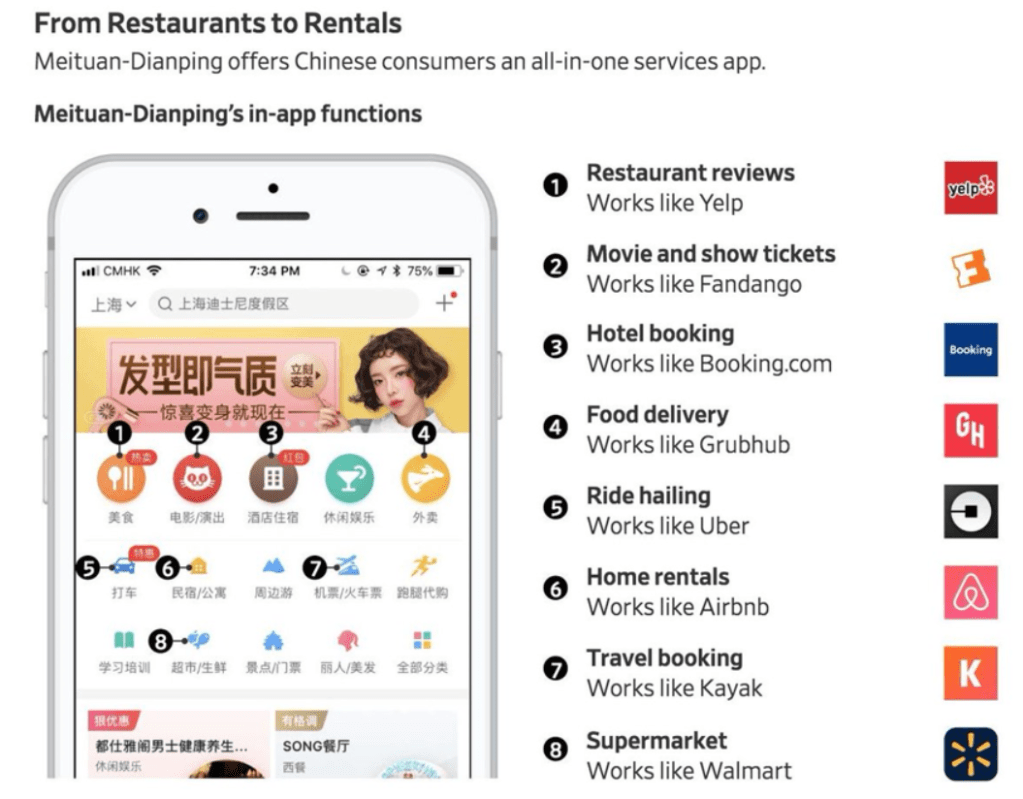
The Wall Street journal used the following chart to describe Meituan’s business, and while it may not be accurate, the benchmark itself is a compliment.
source:Meituan Wants to Be the Grubhub of China
Through an overview of the development history of Meituan in the first ten years, we can find that Meituan has grasped the rising trend of the local life service industry and realized omni-directional traffic entrance through the layout of multiple business segments, thus helping the high-frequency business to drive the low-frequency business and form the traffic cross-realization.
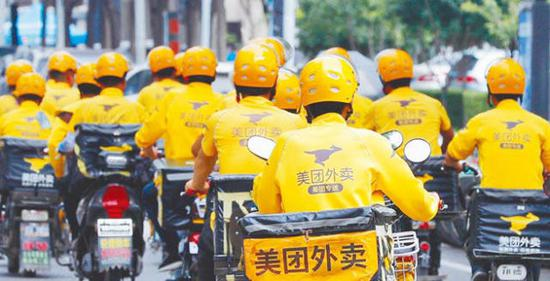
Among them, the most important 2C business of Meituan is takeout. In 2013, Meituan officially launched Meituan takeout, and its takeout business responds to the consumer side’s pursuit of convenience and the merchant side’s pursuit of improving efficiency.Since its launch, Meituan takeout has become a worthy leading enterprise. According to the data of Trustdata, Meituan takeout 2019Q3 has a market share of 65.8%, and its market share is still rising.
With the advent of the digital age, the takeaway market has grown very rapidly in recent years. For takeaway logistics systems, distribution efficiency and user experience are critical. The actual delivery process is ultimately completed by the delivery person (rider). Therefore, to really improve the delivery efficiency, we must not only work on the intelligent dispatching system (order assignment, path planning, ETA), but also continuously improve the “Additional” ability, let them send more faster. Taking this as a starting point, the Meituan R & D team designed the rider’s intelligent assistant to comprehensively improve the rider’s ability in all aspects.
Meituan Takeaway started in 2013 and currently can serve approximately 250 million users, covering more than 1,300 cities, serving more than 2 million merchants, and peak daily orders exceeding 18 million. Meituan’s intelligent delivery dispatch system matches more than 500,000 rider every day. Based on massive data and artificial intelligence algorithms, it ensures that the average delivery time does not exceed 28 minutes. This is also the world’s largest and most complex multi-person, multi-point real-time intelligent distribution scheduling system.
“Tech companies don’t want to disrupt traditional offline companies. They must integrate development, help traditional businesses, and help them digitalize.” On November 8, 2018, Meituan founder and CEO Wang Xing said at the Internet conference.
There is also a hidden crisis behind the Meituan business line. The commissions of major takeaway platforms have been increasing in recent years, and the pressure on many SMEs has risen. Since the outbreak of the coronavirus, many catering industry associations have also called on the platform to reduce commissions, which is also evident. On the other hand, with the expansion of the business line, Meituan is also facing strong management pressure. The Meituan said that one month since the end of January, it recruited 75,000 new delivery staff. Talents who understand management are another big challenge for Meituan. In the past ten years, Meituan has created a business legend in the Chinese Internet industry. Its digital business model is worthy of our learning. Let us wait and see what kind of legend the Meituan will write in the future.
When it comes to sharing economy, I have to say the sharing bikes, which is a typical sharing economy. The emergence of Sharing bikes has made the sharing economy widely spread and developed in China.
As a new thing, sharing bikes has exploded into various problems, only took two or three years.
In 2017, colorful sharing bikes appeared in the streets. People can scan the QR code on the bicycle with their mobile phones to unlock the bicycle. It is very fashionable. Sharing bikes can be the most vivid example of how technology changes life.
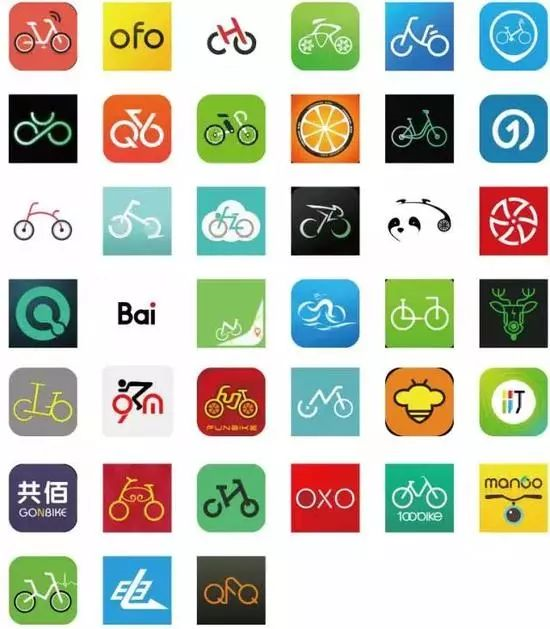
What follows is the fierce competition of sharing bike. Countless companies enter the sharing bike industry. It can be said that how many companies there have, how many colours there is. Each company put bikes in the corners of various cities, resulting in the proliferation of sharing bikes, which full of Subway exits and sidewalks.
brands of sharing bike
There is no denying that the emergence of Shared bikes has facilitated urban travel, especially short commutes. For example, many office workers go to work 10-15 minutes away from the subway station. Before the emergence of shared bicycles, they usually need to walk to work after leaving the subway station. But with bike sharing, they can go to work by bike without having to park the bike to a specific location. It really makes life easier for people.
In 2017, about 500,000 shared bikes are in use in Beijing, with similar penetration in other first-tier cities. At least five separate companies are vying for dominance. As Karl Ulrich (2017) explains, users are crazy about the service. Traffic and subway lines are noticeably better. He has never seen adoption of a hardware-based service happen so quickly.
However, the disorderly over-investment deviates from its original intention of low-carbon environmental protection. The over-investment of shared bicycles caused a great waste of resources. In many cities, as bike-sharing companies are occupying market share frantically, a large number of sharing bikes have put in place, coupled with the inadequacy of the company’s own operating capacity, resulting in many bikes being stacked together. Brings a huge mess to city management.
At the same time, due to the high damage rate of shared bicycles, and because of the randomness of parking, many damaged shared bicycles could not be repaired in a timely manner and were abandoned in many corners of the city. These bicycles have also caused a lot of waste of resources while affecting the city appearance.
Mountain-like bike sharing
The disorderly release of bike sharing has caused a huge burden on city management. Since the second half of 2017, more than ten cities, including Beijing, Shanghai, Guangzhou, and Wuhan, have issued “no-investment orders” for bike sharing. Suspended bicycle companies added new shared bicycles. Although the “investment ban” has been issued, the news that bicycle companies have privately added new shared bicycles in various places is still often exposed by the media. Since the investment ban on bicycle sharing, as of the end of September, Shanghai has cleared 516,000 bicycles. At the same time, in Beijing and other cities that have issued “bans on investment”, illegal bicycle sharing is still banned.
In order to avoid parking chaos and damage to vehicles, Hongwan Chen (2017) deputy director of the Financial Department of the National Development and Reform Commission, said that government agencies must share publicly available credit information in various fields with bicycle-sharing companies. For those who have severely violated the law, they are restricted from using shared bicycles. For those with good credit status, they can give priority to use and provide convenience services such as free deposit.
In the government’s regulation and the competitive role of the bike-sharing market, some companies lacking strength, blindly entered the bike-sharing market and lacked management capabilities were eliminated. China’s bike-sharing market has become stable in recent years. The remaining companies are Internet companies with a large number of users and excellent management capabilities in digital business models, such as Meituan and Alibaba. This kind of company’s operation of shared bicycles can make better use of its circular economy concept of saving resources and avoiding waste. I believe that with the regularization and standardized management of bicycle sharing, people will definitely experience the convenience in digital.
AYuqin Pu, Chibo Huang (2017) Bike-sharing will be introduced into the credit system, and serious discredited users will not be allowed to use the bikes. Retrieved from: https://tech.qq.com/a/20170506/006145.htm
my name is Liuyi Yuan. I am studying Computer Science with Business at University of Exeter. I am from Hebei province, which is in North of China. The reason why I choice this module is that Digital office will become the mainstream in the future, I want to cultivate my knowledge of digital business model.
Welcome to my homepage and I look forward to learning this course with you.



 Hello world